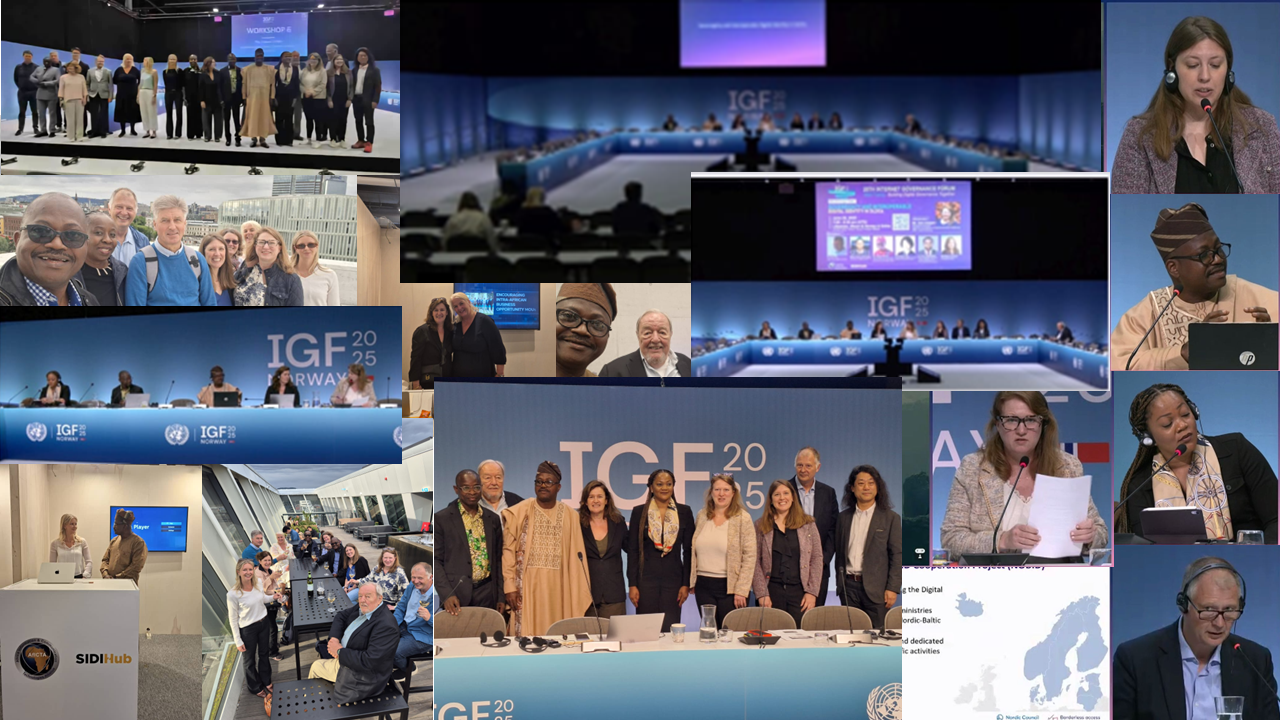
On 25th June, at the 2025 Internet Governance Forum (IGF) in Lillestrøm, Norway, a critical conversation unfolded on one of the most urgent challenges facing developing and least developed countries (DLDCs): how to balance national sovereignty with the need for cross-border interoperability in digital identity systems.
From Global Principles to Regional Practice
Co-hosted by the Africa ICT Alliance (AfICTA), the Sustainable and Interoperable Digital Identity (SIDI) Hub, the Norwegian Tax Agency, and the Norwegian Digitalization Agency, the session brought together a panel of policymakers, technical experts, and civil society actors from across Africa, Asia, and Europe. Together, they explored how digital identity systems can uphold national priorities while enabling international cooperation and inclusion.
Moderated by Gail Hodges, Executive Director at OIDF, SIDI Hub Co-Founder, the workshop opened with a clear call: countries need digital identity systems that function across borders but also safeguard domestic sovereignty over data, infrastructure, and governance.
Debora Comparin, Standards Expert and Chair of the OSIA Initiative at the Secure Identity Alliance, Co-founder of the SIDI Hub, shared the SIDI Hub’s ongoing efforts to promote interoperable and sovereign digital identity systems. These include the development of trust framework mapping and reference architectures. The Hub’s work spans a wide range of cross-continental use cases—from refugee identification to digital education credentials—demonstrating the real-world viability of embedding interoperability and sovereignty by design.
This work has been shaped by input from over 45 countries, collected through six global summits and weekly multistakeholder meetings over the past 18 months. It represents an unprecedented collaborative effort led jointly by the Secure Identity Alliance (SIA), OpenID Foundation (OIDF), and GlobalPlatform, with support from many non profits and open standards organizations.
Debora explained SIDI Hub’s core objective in simple terms: to replicate the essential interoperability, security and trust properties of physical identity documents in the digital world. Using the passport as an example, she outlined key characteristics that must be preserved in digital credentials management, including standardized credential formats, secure and user-controlled methods of exchange, trusted issuance and verifiability, data integrity, non-traceability, and rightful ownership.
She emphasized that these properties must be adapted for every credential type—whether a diploma, professional license, or national ID card—to ensure digital systems provide the same level of trust, security, interoperability and privacy as their physical counterparts.
Regional Models and Global Lessons
• Naohiro Fujie (OpenID Foundation Japan) offered a technical perspective on Japan’s use of open standards like OID4VCI/VP, showcasing real-world applications such as cross-border academic credentials and the integration of Japan’s My Number Card with Apple Wallet. His remarks underscored how international partnerships and standards-based implementations can support both innovation and sovereignty.
• Tor Alvik, Subject Director from Norway’s Agency for Public Management and eGovernment, provided insight from the Nordic-Baltic (NOBID) alliance experience. Norway’s collaborative regional model—centered on shared infrastructure but legal independence—offered practical lessons for African countries pursuing similar objectives.
• Dr. Jimson Olufuye (Chair of AfICTA Advisory Council) underscored Africa’s role in shaping the UN Global Digital Compact and advocated for sovereignty and inclusiveness as core tenets of AfCFTA’s digital identity frameworks.
• Dr. Kossi Amessinou (Benin Ministry of Economy and Finance) presented ‘C’est Moi’, a free government-issued ID card, as a homegrown solution advancing inclusion and interoperability across ECOWAS.
• NIMC DG, Engr. (Dr.) Abisoye Coker-Odusote detailed the evolution of Nigeria’s NIN ecosystem and highlighted its integration efforts at national, regional, and global levels, with support from multistakeholder initiatives like the SIDI Hub.
Panelists converged around several foundational themes:
• Digital identity is key to inclusion
Without recognized digital identity, millions are excluded from vital services such as healthcare, education, finance, and mobility. Countries with early enrolment strategies at birth, demonstrate how strong national systems can promote long-term inclusion. Sharing these models can help close the digital divide across regions.
• Interoperability is essential for regional integration
To realize initiatives like the African Continental Free Trade Area (AfCFTA), seamless identity verification must support the movement of people and services across borders. Regional examples such as ECOWAS in West Africa, and international ones like the EU Digital Identity Wallet and Japan’s bilateral collaborations, offer roadmaps for scalable, interoperable systems.
• Sovereignty must be preserved within interoperable frameworks
Strong data protection, regulatory harmonization, and adaptable policy tools are essential. Jurisdictions at different stages of digital readiness need tailored support, and platforms like SIDI Hub play a pivotal role in meeting them where they are at, helping them assess policy gaps and align with best practices.
Panelists agreed on Actionable Pathways Forward
• Launch regional interoperability pilots
Bilateral and regional pilots— such as between Nigeria and neighboring states—can surface implementation insights and build momentum for larger-scale initiatives.
• Adopt and align with international standards
Governments that design their systems using open standards will be better positioned to achieve both domestic objectives and cross-border interoperability.
• Expand trust framework mapping
Mapping and comparing identity trust frameworks across jurisdictions helps identify policy gaps and alignment opportunities. SIDI Hub’s work in this space offers a blueprint for replication.
• Foster public-private collaboration and citizen awareness
Effective deployment depends on building trust. Engagement strategies—including public education and tangible service delivery (e.g. healthcare access or transport discounts)—can drive adoption and legitimacy.
Sustaining Momentum Through Collective Leadership
Participants strongly supported continued collaboration around open standards, multistakeholder dialogue, and practical policy tools. The SIDI Hub’s work—alongside national governments, civil society, and standards bodies—is shaping the foundations for digital identity systems that are simultaneously interoperable and sovereign.
As countries look to digital identity to power inclusive development, trade, and cross-border mobility, the IGF 2025 workshop showcased a pragmatic and collaborative path forward. Plans are underway for further joint work among the SIDI Hub, Norway, Japan, and African partners to address key friction points in implementing AfCFTA’s digital trade vision.
The outcomes of this session will inform ongoing digital identity strategies across Africa and beyond.
Presentation here
Full rapporteur’s report here.
Watch video here